Model design
Designed the typed object-state representation, belief pathway, and gated mixture transition interface.
Research project · Probabilistic world models
Learning multimodal, object-centric transitions from structured 3D state histories.
Motivation
Partial observation, plural futures
Object motion under occlusion is only partially observed. A deterministic transition tends to average incompatible outcomes, while a short state window can omit the physical context needed for stable long-horizon prediction.
This project separates those challenges. A variational belief encoder summarizes full object histories; a gated Gaussian mixture transition retains multiple plausible 3D displacements at every step.
Infer what cannot be observed, then preserve what can happen next.
Dataset
Synthetic object dynamics
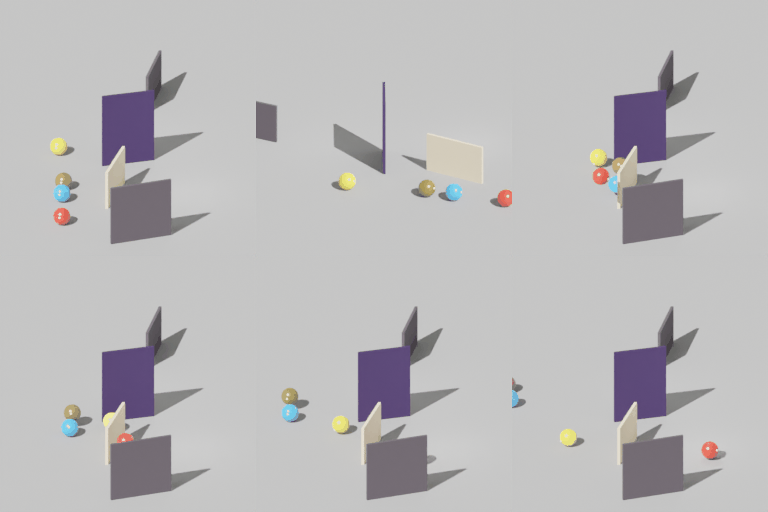
The Scene 3/4 batch contains completed Kubric/Blender simulations with PyBullet physics. Each clip begins with a static observation interval and continues into a dynamic rollout with four tracked balls.

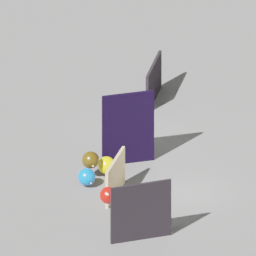

Static scan establishes object identity, geometry, and scene context.
Dynamic frames expose collisions, occlusion, and long-range trajectory changes.
Method
A distribution over motion
The transition model reasons directly over typed 3D object slots, independent of the image encoder and decoder path.
position · Δposition · quaternion · size · type
A full-history posterior supplies 16-dimensional object context.
Causal attention models temporal and inter-object interactions.
Mixture weights, means, scales, and a motion gate define displacement.
Predicted state is fed back to test stability across the full horizon.
Experiment
Configuration at a glance
Evaluation includes mean, MAP, oracle-component, and sampled rollouts, plus teacher-forced mixture diagnostics.
Results
Run 0006 · Scene 4 validation
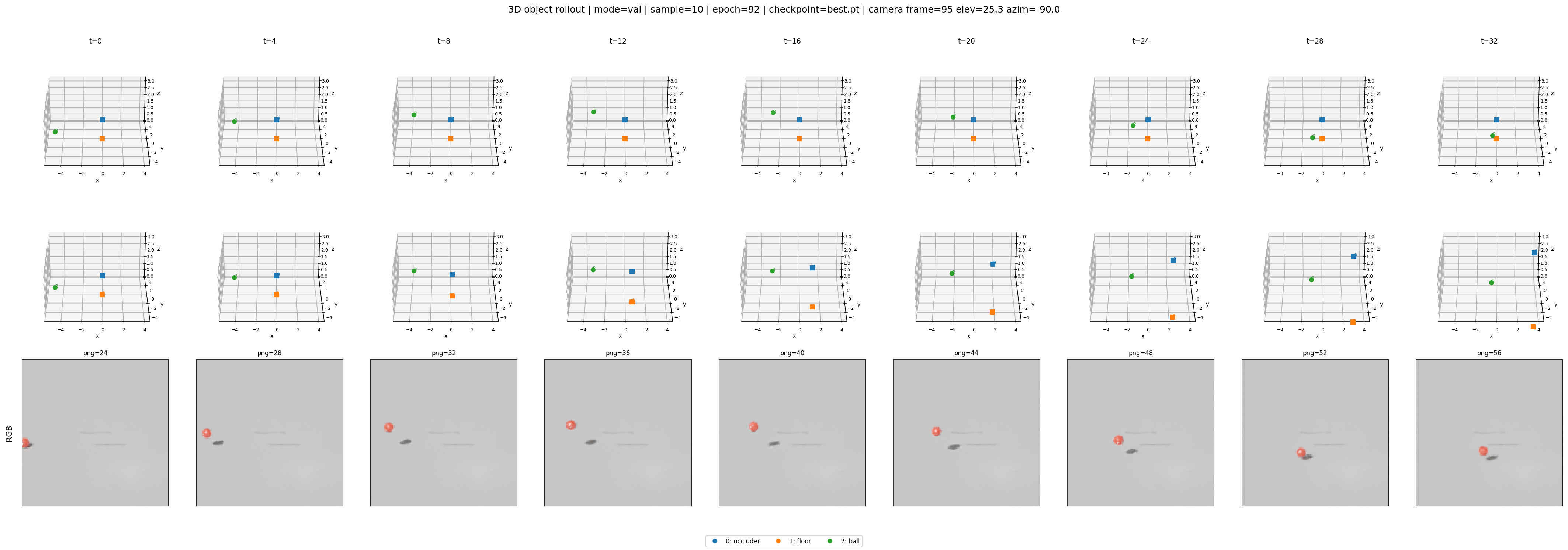
Ground truth and mean prediction reveal object-wise drift across the complete forecast.
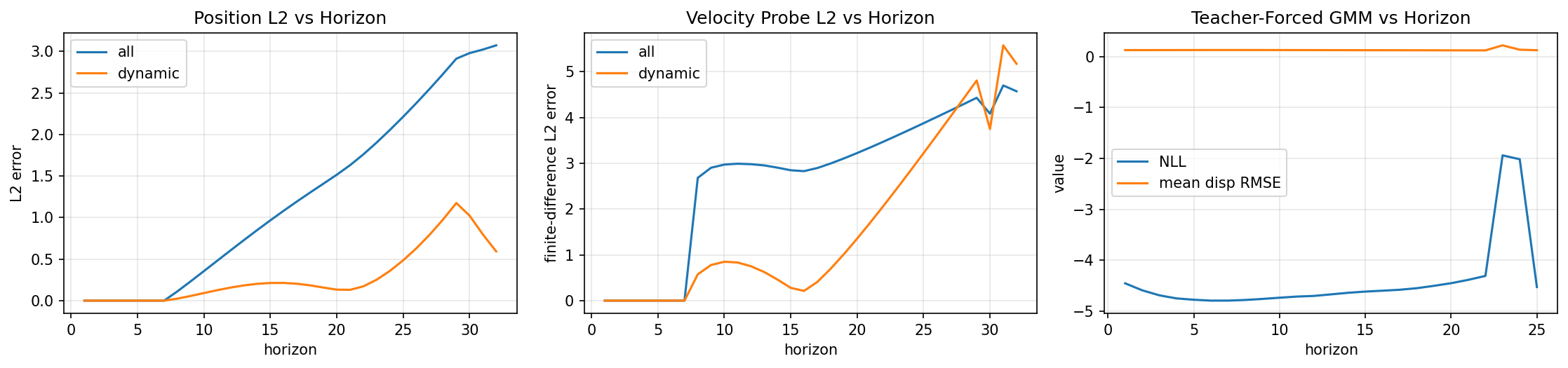
Per-step curves show where autoregressive error begins to compound.
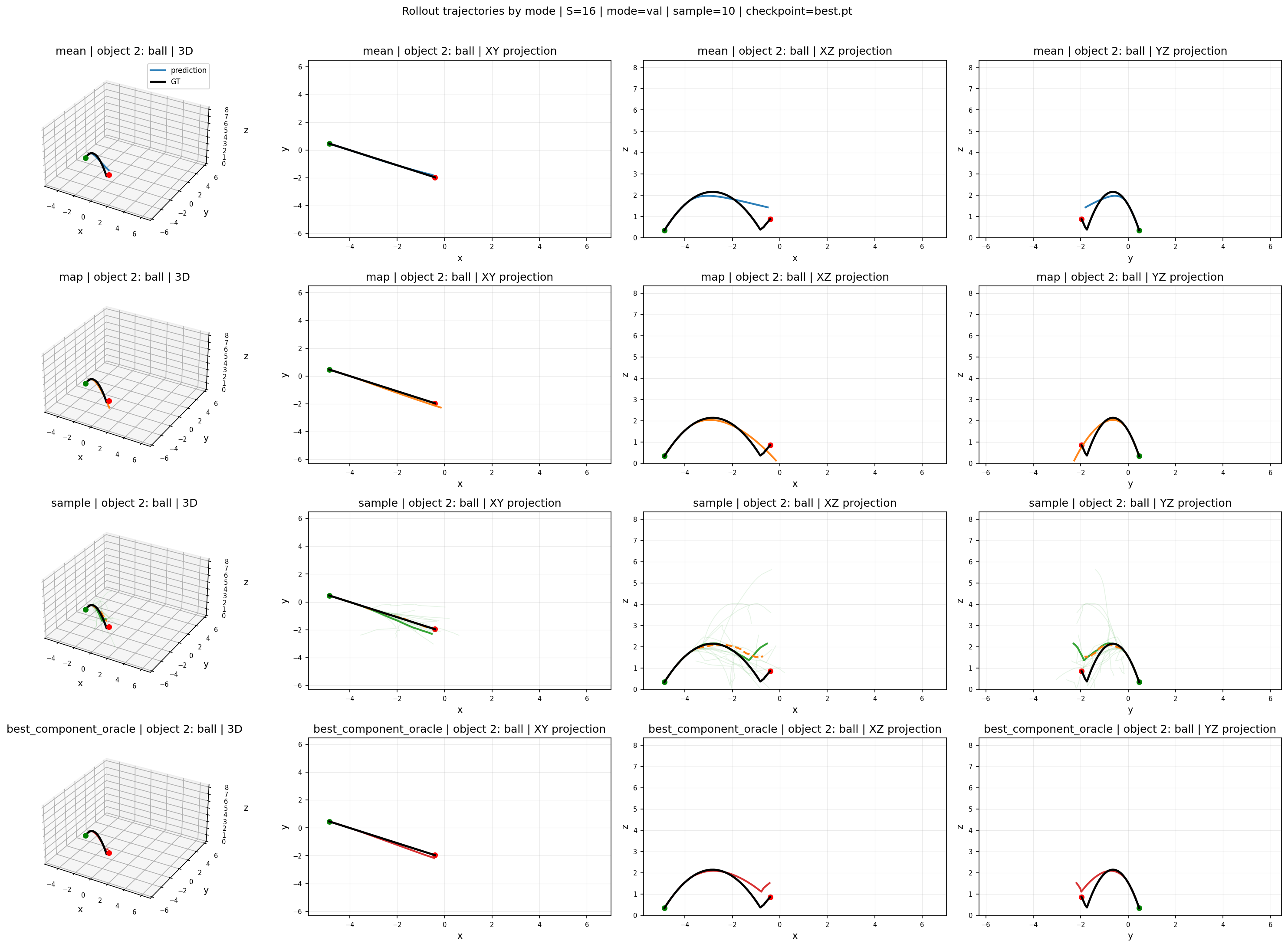
Sixteen fixed stochastic rollouts expose diversity, coverage, and spread.

Teacher-forced analysis inspects mixture weights, displacement components, and predictive scale.
My contribution
Research engineering
The statements below are publication placeholders and should be aligned with the final authorship breakdown before release.
Designed the typed object-state representation, belief pathway, and gated mixture transition interface.
Built deterministic data splits, checkpointing, distributed training, gradient clipping, and experiment configuration.
Implemented rollout modes, best-component analysis, sampled trajectory metrics, coverage, and GMM diagnostics.
Created reproducible 3D visualizations and metric artifacts for diagnosing long-horizon behavior.
Implementation
Reproducible by construction
The trainer supports single-GPU and torchrun execution, with configuration and vocabulary stored beside each checkpoint.
python train_oracle_particle_transition.py --config configs/oracle_particle_transition.json

# distributed
CUDA_VISIBLE_DEVICES=0,1,2,3 torchrun \
  --nproc_per_node=4 \
  train_oracle_particle_transition.py \
--config configs/oracle_particle_transition.jsonCitation
Venue and publication details remain replaceable until the paper is released.
@article{author2026oracle,
  title   = {Belief-Aware Oracle Particle Dynamics},
  author  = {Kang, Yin and others},
  journal = {[Venue]},
  year    = {2026}
}